

New Online Evaluation Rule Editor
Creating an online evaluation rule now happens in a side panel. Click Evaluator, choose LLM-as-a-Judge, Decision model or Code evaluator, and set the name and prompt or code on the left, with the scope, filtering and sampling, scores and cost limit on the right. A new judge or decision model starts from a set of templates that already use the right variable for the scope you picked, or you can click Type your prompt to write your own. The Enabled toggle in the footer lets you create a rule paused and switch it on later.
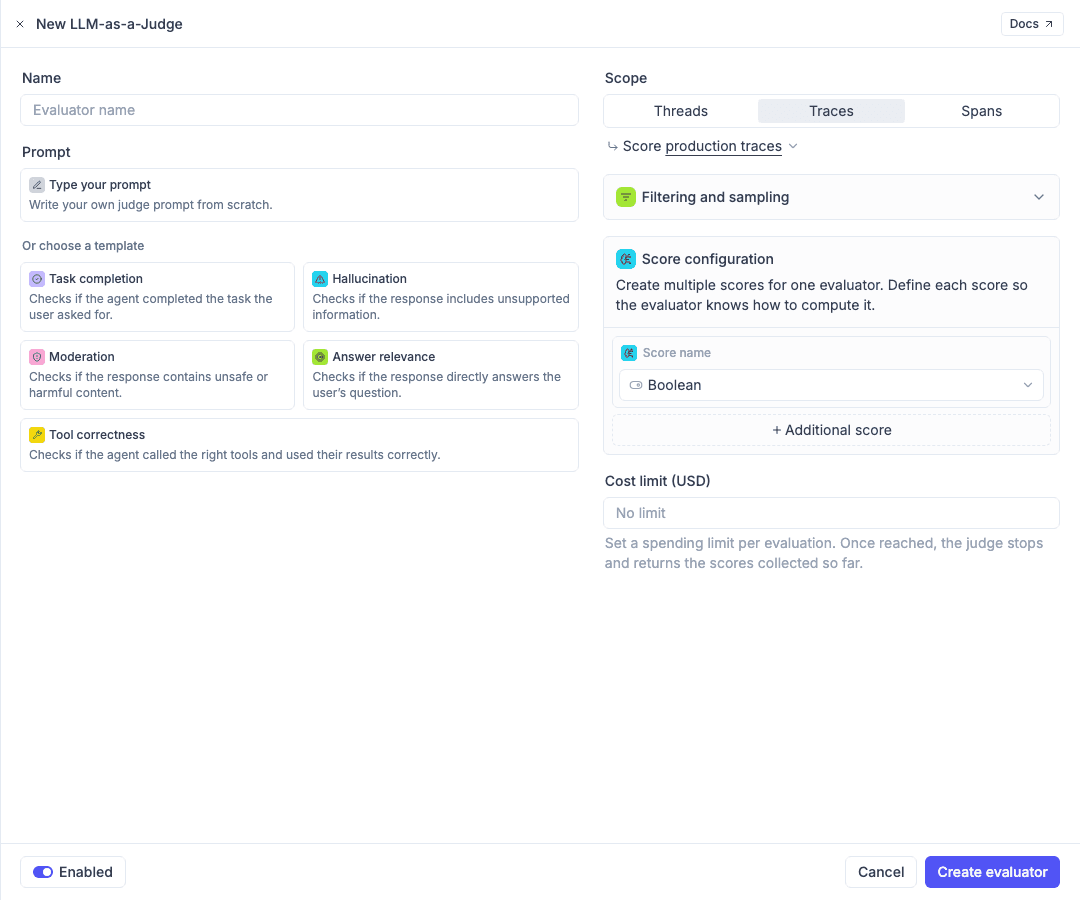
Learn more in the Online Evaluation rules docs.
Cohere Integration
Opik now has a native integration for the Cohere Python SDK. Wrap your client with track_cohere and every chat() and chat_stream() call is logged with its messages, response, model and token usage. The async client is supported too, so Command models show up next to the rest of your traces.
Learn more in the Cohere integration docs.
Bug Fixes & Improvements
- View an older dataset or test suite version — Open a version from the history to browse its items without restoring it.
- Playground runs on the server — Running a Playground experiment on a regular dataset and stopping it now happen on the server, and results stay on screen while a run progresses. Runs on an empty dataset or test suite are blocked, and rate limit or rejected-role errors say what to do next.
- Multiple media parts from one variable — A single Playground variable holding a list now sends one image, video or audio part per entry.
- OpenTelemetry project routing — Set the
opik.project_nameattribute on spans to send them to a specific project, which helps when a Collector processor drops theprojectNameheader. - Environment filter on threads — The Threads tab can be filtered by environment, and the logging guide explains how threads get theirs.
- Internal traces in threads — Thread Messages hide internal traces behind a toggle and mark them with an Internal badge.
- Alert custom fields — Alerts take optional custom fields that are included in the EventBridge event.
- New models — Claude Haiku 5.5 and Sonnet 5.5 are available in the Playground and online evaluation, and the online evaluation defaults for OpenAI and OpenRouter are GPT 5.5.
- Model parameters follow each model — Reasoning effort levels, defaults and OpenRouter parameters now match what each model supports, and base64 images, video and audio are sent to Vertex AI as inline data.
- Clearer project name errors — Creating a project with a name that already exists shows a clear message.
- Prompt library and Playground — Saving to the prompt library twice by double-clicking creates one version, and unsaved edits to a library prompt are kept when you leave the Playground.
- Test suites — Runs finish when the assertion judge can’t run, falling back to the next provider.
- OpenAI Decisions API tracing — The Python and TypeScript OpenAI integrations log Decisions API calls.
- SDK tracing — Bedrock
invoke_modelClaude and Nova streams keep their tool calls, thinking and citation blocks, parallel tool calls from streamed TypeScript OpenAI responses stay separate, and Gemini thinking and tool-use prompt tokens are counted in TypeScript usage. - SDK evaluation — Aggregates report how many scores they left out, and conversation windows whose assistant reply has no text are not graded.
- Pricing — OpenTelemetry spans that report the provider as its API host are priced, and workspace metrics include authored feedback scores.
- Self-hosting — Redis Sentinel is supported, with a setup guide, and the Python SDK is published to PyPI with Trusted Publishing.
- Dashboards — The Add widget menu makes dashboard editing and Ollie widgets easier to find.
- Documentation — New judge metric and judge alignment tutorials, a guide to separating dev, staging and prod with environments, and updated guides for test suite assertions, Diagnostics and OpenTelemetry.
Performance Improvements
- Faster span and trace reads — Span, trace and thread reads, plus project size and feedback score name lookups, are bounded to the project’s span weeks, and large span and trace write payloads are streamed.
And much more! 👉 See full commit log on GitHub
Releases: 2.2.104, 2.2.105, 2.2.106, 2.2.107, 2.2.108, 2.2.109, 2.2.110, 2.2.111, 2.2.112, 2.2.113, 2.2.114, 2.2.115, 2.2.116, 2.2.117, 2.2.118, 2.2.119