
You’ve built an agentic system that coordinates retrieval, reasoning, and response generation across multiple specialized tasks. Now you need to optimize it. Fine-tuning separate models for each task would cost tens of thousands in compute and lock you into countless training cycles, delaying your launch by weeks. Prompt engineering gets you started quickly, but you hit a ceiling because you’re stuck manually testing variations of “Classify this query as billing, technical, or general” hoping to find the magic phrasing that works.
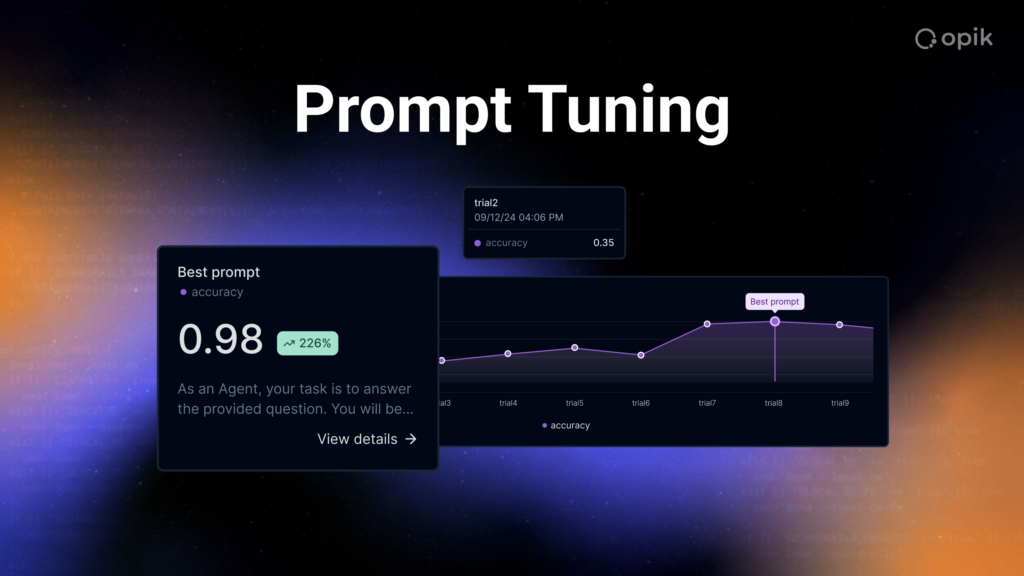
Prompt tuning offers a more refined approach. Google researchers introduced this parameter-efficient technique, which learns a small set of continuous vectors, or soft prompts, that steer a frozen model toward task-specific behavior. These learned embeddings optimize the results through gradient descent the same way model weights do, but you’re training thousands of parameters instead of billions. The base model stays frozen, preserving its general knowledge while gaining specialized capabilities through these learned prompts.
For researchers and engineers building production agentic systems, this efficiency matters. When your architecture routes queries to specialized reasoning modules, coordinates tool calls, and maintains conversation state across turns, you need multiple specialized behaviors from a single model deployment. Prompt tuning lets you adapt one foundation model while diversifying the individual tasks without the infrastructure burden of managing separate fine-tuned checkpoints. You get performance that approaches full fine-tuning at a fraction of the computational cost. And with modern tools like Opik’s Agent Optimizer, you can automate that optimization process.
Steering Models without Retraining
The fundamental idea behind prompt tuning is simply this:
If you can steer model behavior by prepending carefully chosen text to your input, you should be able to learn optimal prompt representations directly through backpropagation.
Traditional fine-tuning updates all parameters in a model, which could mean 175 billion weights for a model like GPT-3. Prompt tuning introduces as few as 20 trainable vectors at the input layer. Only these prompt parameters get updated during training. The model itself remains unchanged.
Soft prompts differ fundamentally from the hard prompts you craft manually. A hard prompt is discrete text selected from the model’s vocabulary. For example, “Classify this customer query as billing, technical, or general support.” Soft prompts are continuous embeddings that exist in the same space as word embeddings but don’t correspond to actual words. They’re vectors of floating-point numbers learned through optimization, not human-readable instructions.
Let’s look at a sentiment classification task. With prompt engineering, you test variations like “Classify this text as positive or negative” versus “Determine the sentiment.” You hope that one of these hard prompts performs better, but the results are brittle. Minor wording changes produce unpredictable swings in performance. With prompt tuning, you initialize a set of soft prompt vectors and let gradient descent find the optimal representation. The model learns patterns that a human couldn’t articulate in natural language. The research from Google demonstrates these learned prompts consistently outperform handcrafted prompts as the model size scales.
During this inference process, soft prompts are concatenated with input tokens and processed by the frozen model as if they were part of the original text. The model processes these learned vectors and adjusts its behavior accordingly, producing task-specific outputs without modifications to internal weights. For agentic systems, this modularity is powerful. You can train separate prompt files for different capabilities, such as query classification, response generation, or tool selection. Then you can swap the prompt files at runtime. This approach allows you to maximize the quality of your results using a single base model deployment, multiple specialized behaviors, and minimal storage overhead.
From Initialization to Inference
The prompt tuning process follows standard supervised learning, except that you’re optimizing a small set of prompt parameters instead of the entire model. Training begins by defining the soft prompt’s structure. This structure is typically between 10 and 100 tokens, though the optimal length ultimately varies based on the task complexity. These prompt tokens are initialized as embedding vectors, either using heuristics or randomly:
- Heuristic initialization uses embeddings from actual words that you give the model as a starting point closer to natural language patterns. For example, you might initialize with embeddings for “Classify the sentiment” as a seed, though optimization quickly diverges from these values.
- Random initialization takes samples from a standard distribution. For example, you might sample 20 vectors of 768 dimensions from a standard distribution, which are molded into effective prompt representations during training.
Once initialized, soft prompts are prepended to your input sequence. If your input is “The product arrived damaged and unusable” and you’re using 20 soft prompt tokens, the model processes 20 learned vectors followed by your actual input tokens. On each forward pass, this concatenated sequence flows through the frozen model’s layers. The model generates predictions based on the combined input, which are compared against the ground truth labels using a task-specific loss function, such as cross-entropy for classification or perplexity for generation.
During backpropagation, gradients flow backward through the network to update the soft prompt parameters while the model’s weights stay fixed. This dramatically reduces how many parameters are trained. Where fine-tuning the model updates 175 billion parameters, prompt tuning might update just 2,000 parameters from the 20 tokens and 100-dimensional embeddings. Using standard optimizers like Adam, adjusts soft prompt embeddings to minimize loss on your training data. Over multiple epochs, these vectors learn representations that consistently guide the frozen model toward task-specific behavior.
Training stability primarily depends on these factors:
- Prompt length: If the prompts are too short, the model lacks sufficient signal to capture task complexity. If the prompts are too long, you’re training more parameters without proportional benefit.
- Learning rate: Because you’re optimizing embeddings in the same space as the model’s learned representations, aggressive learning rates push soft prompts into regions that produce degenerate behavior.
Validation monitoring catches these issues by tracking loss and metrics on held-out data, watching for overfitting or unstable dynamics.
The advantage is that these experiments are cheap. You can test different prompt lengths, initialization strategies, and hyperparameters without expensive compute commitments.There are open-source libraries to make your implementation straightforward, including Hugging Face PEFT, OpenPrompt, and Google’s prompt-tuning framework. Each of these libraries offer well-tested defaults that reduce the need for extensive hyperparameter tuning.
Once trained, soft prompts are stored as a small file containing the optimized embedding vectors. At inference, you load these vectors, prepend them to new inputs, and pass the combined sequence through the frozen model. The model processes soft prompts exactly as during training, producing task-specific outputs with minimal additional computational overhead compared to normal inference.
Prompt Tuning Wins for Multi-task Agentic Systems
Prompt tuning’s real value emerges when you compare it against the alternatives, such as prompt engineering and fine-tuning. The advantage of prompt tuning is especially prevalent in the context of agentic systems that coordinate multiple specialized tasks. Prompt engineering relies on manual trial-and-error testing of text instructions. It requires no training data but produces brittle, unpredictable results where small wording changes cause performance swings. Fine-tuning adapts models by retraining all parameters, which produces strong performance but demands substantial compute. Fine-tuning billions of parameters for some models requires GPUs, significant memory, days of training time, and hundreds of gigabytes of storage for the specialized model.
Prompt tuning offers a path that balances the two approaches. Prompt tuning automates the search for optimal prompts through gradient descent on labeled data, training thousands of parameters instead of billions, while keeping the base model frozen.
The PEFT research shows that as models scale beyond 10 billion parameters, prompt tuning matches fine-tuning performance while requiring fewer trained parameters and occupying minimal storage.
The trained prompts make rapid experimentation practical because you can test 10 different configurations in the time it takes to fine-tune once.
This efficiency makes prompt tuning particularly valuable for agentic systems where AI coordinates multiple specialized tasks. Consider a travel booking agent requiring distinct capabilities for search, comparison, booking, and confirmation. Fine-tuning separate models for each capability would require massive infrastructure. Prompt tuning makes it easy for you adapt a single base model to all four tasks by training four small prompt files for the various tasks. The base model handles all inference while you swap prompt files based on the active task.
The prompt tuning architecture reduces training costs and deployment complexity. Storage and deployment costs remain nearly constant with prompt tuning rather than scale linearly with fine-tuned models. Four prompt files might total 50 KB; four fine-tuned models require 1.4 TB of storage and separate deployment endpoints.
The low training cost also enables rapid experimentation. Agentic systems require continuous improvement as user feedback reveals edge cases and new capabilities get added. You can quickly test 10 different prompt configurations. When using LLM evaluation metrics to guide improvements, faster feedback loops mean more iterations and better solutions. Opik’s evaluation features empower you to measure performance across prompt variations and identify the best configurations systematically.
Avoid the fine-tuning risk of catastrophic forgetting because prompt tuning keeps your base model frozen. With fine-tuning, your model eventually becomes so specialized that it loses general knowledge. With prompt tuning, your model retains all its original knowledge while soft prompts steer existing knowledge toward the defined, task-specific behavior. An agent handles specialized technical troubleshooting through one prompt file while maintaining natural conversation skills from pretraining.
Modern agentic architectures often coordinate multiple specialized AI agents. Prompt tuning offers modularity that extends to dynamic task allocation. Through agent orchestration, the appropriate prompts are selected based on the classified user intent and injects the right soft prompts at runtime.
The Limitations of Prompt Tuning
Prompt tuning isn’t universally applicable. Understanding limitations helps you choose when to use it and when alternatives make more sense. The most significant challenge is interpretability. Soft prompts are opaque vectors of floating-point numbers. You can’t inspect them to understand what “instruction” the model receives. This makes debugging harder when behavior doesn’t match expectations. If your fine-tuned model produces incorrect outputs, you can examine training data for label errors. With prompt tuning, the learned prompt representation offers no insight into how or why it steers model behavior.
This opacity matters most in domains requiring explainability. If you need to justify model decisions to regulators or users, soft prompts provide no legible rationale. For high-stakes applications in healthcare, legal, or financial domains, the interpretability tradeoff might be unacceptable.
Prompt tuning’s effectiveness increases with model size, so it might not be the right choice for smaller models. On models under 1 billion parameters, research shows that prompt tuning significantly underperforms fine-tuning. The gap narrows as you scale to 10 billion parameters and largely disappears at 100 billion+ parameters. For teams working with smaller models—deploying on edge devices or optimizing for inference speed—fine-tuning might deliver better task performance. Prompt tuning shines when working with large foundation models where computational savings are substantial and performance quality is competitive.
Prompt tuning can be sensitive to initialization choices and hyperparameters. Random seeds occasionally produce poor local optima. Finding the right learning rate requires experimentation. Low training cost makes it feasible to run multiple trials with different initialization strategies, but you can’t treat prompt tuning as entirely plug-and-play. Use the available open-source libraries to provide reasonable defaults that work well across diverse tasks.
Prompt tuning works best when you need to adapt a large frozen model to specific tasks with moderate amounts of labeled data. It’s less suitable when you need to maximize possible performance, when working with very small models, or when you lack training data entirely. For complex multi-step reasoning or when task requirements extend far beyond the base model’s capabilities, fine-tuning or retrieval-augmented generation may be better choices. Prompt tuning excels at steering existing model knowledge, not teaching fundamentally new information.
Scaling Prompt Optimization to Build Reliable Agents
Prompt tuning demonstrates the fundamental principle that learned prompts outperform hand-crafted ones. The original research from Google showed that as models scale beyond 10 billion parameters, prompt tuning matches fine-tuning performance while training 1000x fewer parameters.
But production agentic systems involve far more than optimizing individual model calls. Modern agents coordinate retrieval, execute multi-step reasoning, call external tools, and generate responses across diverse contexts. Each of the core components, including prompts, few-shot examples, tool schemas, and model parameters, affects the system performance. Optimizing manually means testing countless combinations. It’s time-consuming and rarely reaches optimal configurations.
Automated prompt optimization extends prompt tuning principles to complete agentic workflows. Modern optimization algorithms generate and test discrete text-based prompts, evaluating them against your performance criteria. This combines the automation that makes prompt tuning effective with the interpretability of text-based prompts you can read and modify.
Opik provides end-to-end infrastructure for building and optimizing agentic systems, integrating LLM observability, LLM evaluation, and automated optimization into a unified workflow. With Opik, you can build your agents with the right set of tools:
- Facilitate LLM tracing for every interaction to understand exactly how your agent behaves. Opik captures the complete execution path so you can identify bottlenecks and errors before users do.
- Evaluate systematically using automated metrics that matter for your use case. Opik supports heuristic metrics and LLM-as-a-judge evaluations for subjective criteria, giving you the ground truth needed for optimization decisions.
- Optimize automatically with specialized algorithms, including few-shot Bayesian optimization, evolutionary algorithms, and LLM-powered meta prompting.
Opik is available from the open-source project or with an enterprise-ready platform hosted in the cloud. Opik is built on the same principles that make prompt tuning effective: systematic optimization over trial-and-error, measurement over intuition, and automation over manual effort.