
Observability for LiveKit with Opik
LiveKit Agents is an open-source Python framework for building production-grade multimodal and voice AI agents. It provides a complete set of tools and abstractions for feeding realtime media through AI pipelines, supporting both high-performance STT-LLM-TTS voice pipelines and speech-to-speech models.
LiveKit Agents’ primary advantage is its built-in OpenTelemetry support for comprehensive observability, making it easy to monitor agent sessions, LLM calls, function tools, and TTS operations in real-time applications.
Getting started
To use the LiveKit Agents integration with Opik, you will need to have LiveKit Agents and the required OpenTelemetry packages installed:
Environment configuration
Configure your environment variables based on your Opik deployment:
Opik Cloud
Enterprise deployment
Self-hosted instance
If you are using Opik Cloud, you will need to set the following environment variables:
To log the traces to a specific project, you can add the
projectName parameter to the OTEL_EXPORTER_OTLP_HEADERS
environment variable:
You can also update the Comet-Workspace parameter to a different
value if you would like to log the data to a different workspace.
Using Opik with LiveKit Agents
LiveKit Agents includes built-in OpenTelemetry support. To enable telemetry, configure a tracer provider using set_tracer_provider in your entrypoint function:
Make sure to create a .env file with the environment variables you configured above as well as LiveKit,
DeepGram and OpenAI API keys and credentials. It should look something like this:
Then, run the application with following command:
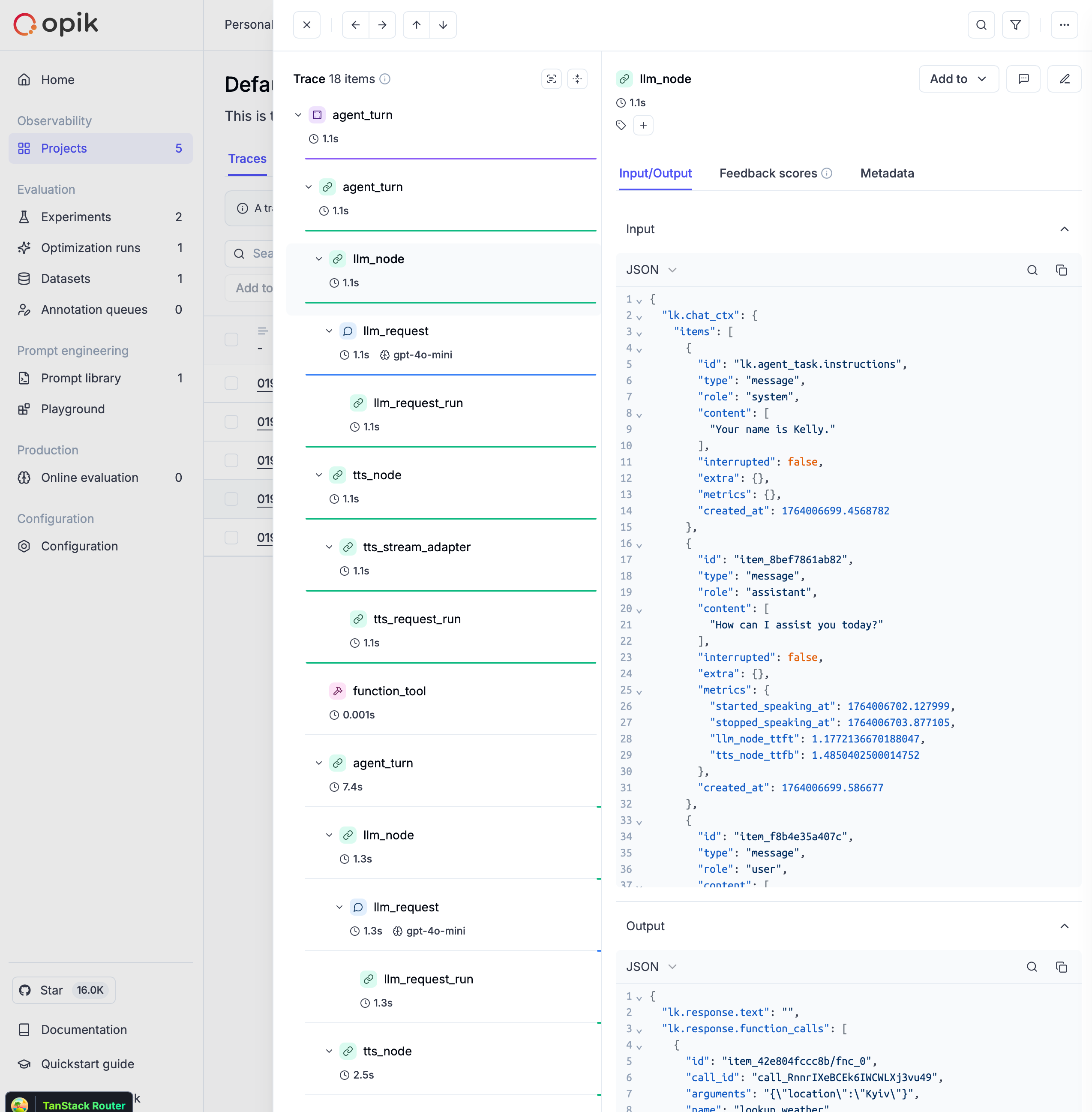
After a few seconds, you should see traces in Comet ML:
What gets traced
With this setup, your LiveKit agent will automatically trace:
- Session events: Session start and end with metadata
- Agent turns: Complete conversation turns with timing
- LLM operations: Model calls, prompts, responses, and token usage
- Function tools: Tool executions with inputs and outputs
- TTS operations: Text-to-speech conversions with audio metadata
- STT operations: Speech-to-text transcriptions
- End-of-turn detection: Conversation flow events
Further improvements
If you have any questions or suggestions for improving the LiveKit Agents integration, please open an issue on our GitHub repository.