
The moment an LLM can decide which tool to call next, you’ve crossed a threshold. You’ve moved from building a chatbot to building an autonomous system that reasons about problems, takes actions, and adapts based on feedback. This shift from passive generation to active problem-solving is what orchestration makes possible.
Orchestration isn’t just about stringing together API calls. It’s the architectural layer that manages non-deterministic control flow, coordinates iterative reasoning loops, and provides the guardrails that make autonomous behavior reliable enough for production. This post explains what an agent orchestrator does and how it differs from traditional workflow engines, so you can build AI agents that deliver value at scale.
The Orchestrator Manages Control Flow
Before diving into what orchestrators do, you need to understand the fundamental architectural choice they represent. The most useful distinction in agent design isn’t about which LLM you’re using or how many tools you’ve connected. It’s about control flow. That is, who or what decides what happens next.
In a traditional workflow, you orchestrate LLMs and tools through predefined, hardcoded paths. An LLM might summarize text or classify intent, but the overall sequence of operations is locked down by your application code. This approach is predictable, testable, and aligns with the last decades of building reliable software.
In an agentic system, the LLM itself LLM decides the sequence of operations required to achieve a goal and dynamically directs its own processes and tool usage. If the LLM can change the application’s control flow, it’s an agent. Agents cede control to the model, unlocking flexibility and adaptability, at the cost of predictability.
The orchestration layer — also called the agent core or strategy layer — is the engine responsible for managing this control flow.
The Predictability-Adaptability Continuum
In a simple workflow, the orchestrator might be nothing more than a state machine executing predetermined steps. In a true agentic system, the orchestrator’s role becomes far more complex: it mediates all communication between the reasoning engine (LLM), memory systems, and tool-execution layers, and it manages the iterative, non-deterministic loop that defines agent behavior.
This isn’t a binary choice. You’re not deciding “agent or not” — you’re selecting a point on what researchers call the “predictability-adaptability frontier.” A simple sequential pipeline sits closer to the predictable workflow end. A complex conversational system built with frameworks like AutoGen operates on the adaptive agent end. The orchestrator’s design is how you implement this architectural tradeoff.
The TAO Cycle: The Fundamental Unit of Agentic Behavior
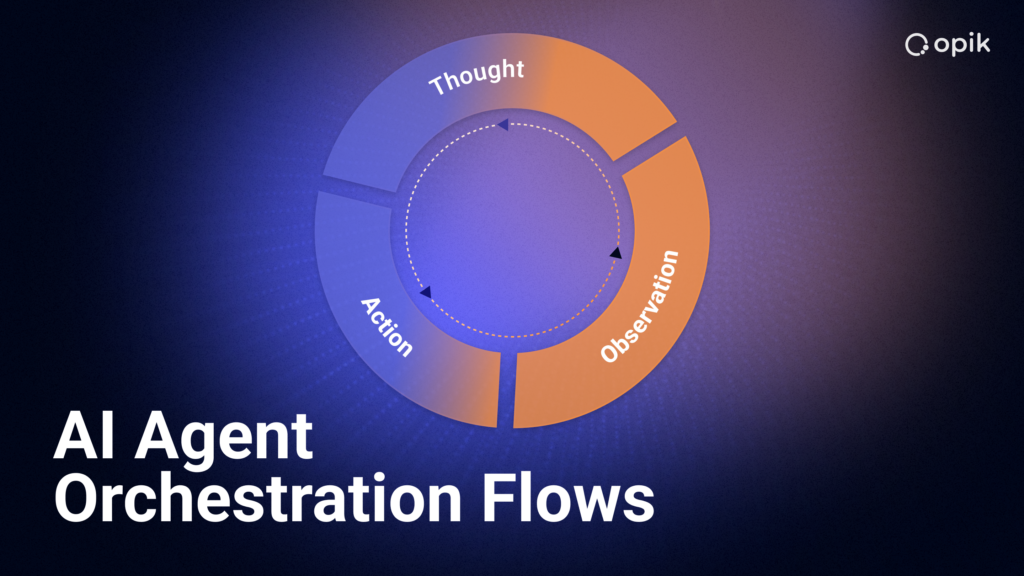
The iterative loop that defines agentic operation is the Thought-Action-Observation (TAO) cycle. This pattern breaks down complex tasks into manageable, iterative steps that an LLM can handle reliably.
Here’s how the cycle works:
Thought: The agent’s reasoning engine analyzes the current state, the persistent goal, and its available memory, then decides on the next step required to move closer to the goal. This “thought” manifests as a structured plan or a decision to use a specific tool. Techniques like Chain-of-Thought prompting (CoT) generate a step-by-step textual trace of this reasoning, while frameworks like ReAct (Reasoning and Acting) explicitly interleave reasoning steps with action steps.
Action: The orchestrator parses the LLM’s “Thought” — typically a structured JSON object specifying a function call — and executes the chosen action. This usually means using an external tool: querying a database, calling an API, or running code.
Observation: The orchestrator captures the result of the “Action”, which is some kind of output, like data returned from an API or an error message, and passes this “Observation” back to the LLM.
This “Observation” feedback from the environment informs the LLM’s next “Thought,” starting the next loop.
The TAO cycle continues until the orchestrator or the agent determines the goal has been achieved.
While each individual TAO cycle represents a single decision point small enough for an LLM to handle reliably, this localized reliability doesn’t ensure end-to-end production reliability. LLMs are inherently non-deterministic, and even small 1% chances of failure compound over multi-step tasks. A 10-step agentic process with a 99% success rate at each step (0.99^10) has only a ~90.4% chance of succeeding, introducing an unacceptable ~10% failure rate for production systems.
This mathematical reality reframes the orchestrator’s primary function. Its purpose isn’t merely to execute the loop but to manage the compounding unreliability of the chain. Features like stateful memory, robust error handling, conditional branching, and cyclical execution are fundamental architectural necessities for achieving reliable agentic behavior in production.
Tool Calling: The Bridge from Reasoning to Action
The “Action” phase of the TAO loop, implemented via tool calling (also called function calling), is how agents move beyond text generation to interact with APIs, databases, and other software systems. This capability is both the source of an agent’s power and a primary source of production complexity.
The technical mechanics involve a structured, multi-step interaction mediated by the orchestrator:
Manifest Definition: You provide the LLM with a “manifest” of available tools, typically via a system prompt or initialization. Each tool gets a name, a clear semantic description of its purpose, and a strict JSON Schema detailing its required parameters.
LLM Tool Selection: During the “Thought” phase, the LLM uses the manifest descriptions to decide if an external action is needed. If so, it generates a structured JSON object specifying which function to call and what arguments to pass.
Orchestrator Execution: The orchestration layer receives this JSON, parses it, validates it against the schema, and executes the corresponding function in native code.
Observation Feedback: The orchestrator receives the result of this execution, such as a JSON response from a weather API, an error stack trace, etc. Then it packages the result as an “Observation” and feeds it back to the LLM for the next TAO cycle.
This integration introduces a critical tradeoff between flexibility and security. By granting an agent access to tools, you expose sensitive functionalities like code execution or database access. More critically, you open a channel for untrusted data from external sources, like a malicious website scraped by a tool, to be fed back into the agent’s reasoning loop as an “Observation.” This creates a vector for indirect prompt injection attacks, where the agent is compromised not by the user but by the data it interacts with.
Testing and Building Tool-Centric Agents
The non-deterministic nature of an LLM’s tool selection renders traditional software testing insufficient. You can’t simply test if your get_weather function returns relevant data. You must test if the agent’s reasoning reliably chooses to call get_weather with the correct parameters under the correct conditions.
A formal evaluation framework for tool-using agents must assess the following criteria:
Tool Selection Accuracy: Did the model choose the correct tool or sequence of tools for the given task?
Parameter Correctness: Did the model provide accurate, well-formed, and appropriate parameters for the tool invocation?
Error Handling: How effectively did the model handle unexpected conditions, tool failures, or error messages returned in the “Observation” phase? Can it self-correct and retry?
Task Completion: Did the agent’s sequence of tool calls successfully reach the desired end state and accomplish the goal?
Consistency: Does the model consistently use the same tools for the same tasks, and are the results stable across invocations?
Navigating Production: The Orchestrator’s Real Job
Deploying autonomous, non-deterministic systems surfaces challenges that can’t be solved at the model or prompt level. These production issues must be addressed architecturally, with the orchestrator playing a central role.
A common mistake in agent design is what developers call “API thinking” — defaulting to familiar, testable RPC (Remote Procedure Call) patterns and simply wrapping existing APIs with a JSON schema. This approach is brittle because it fails to account for the non-deterministic nature of the LLM.
A more robust, production-grade approach treats tool use as a “model-facing protocol” designed for “intent mediation” and “context exchange,” as exemplified by the Model Context Protocol (MCP). This model-first design philosophy implies that tools must be built differently. They need rich, semantic descriptions that clearly explain their purpose and parameters to a model, not just a human. They must be resilient to non-deterministic or malformed inputs. Most crucially, they must return model-readable observations.
An HTTP 500 status code is useless to an LLM. An “Observation” string like “Error: The database connection failed. Please check your credentials or try again in a few minutes” provides actionable feedback that a well-designed agent can use to self-correct on its next loop. This critical “intent mediation” orchestration layer handles retries, backoffs, and the translation of system errors into LLM-readable observations.
The Reliability Problem
LLM non-determinism means the same input can lead an agent down different reasoning paths, resulting in inconsistent outcomes that are unacceptable for mission-critical business processes. A single hallucinated value in an early step can cascade and corrupt the entire subsequent workflow.
The primary mitigation strategy is architectural: offload precision to deterministic tools. An LLM is a reasoning engine, not a calculator. Don’t rely on an LLM for mathematical calculations, date comparisons, or structured data retrieval. Instead, provide the agent with deterministic tools to perform these precision tasks reliably.
For high-stakes or irreversible actions like processing customer refunds or deleting database entries, the agent’s final “Action” shouldn’t be execution but a request for human confirmation. This human-in-the-loop pattern is explicitly supported in frameworks like LangGraph and serves as a crucial fail-safe.
The Black Box Debugging Problem
Debugging an agent failure is fundamentally different from debugging traditional software. The failure is rarely a code bug like an exception. Errors are often caused by a flaw in the emergent reasoning chain. The agent called the wrong tool, or it misinterpreted the tool’s response. Traditional logging and error tracking are useless for diagnosing these reasoning failures.
Production-grade agents require a specialized “Agent Observability” stack to extend LLM observability. It’s not enough to trace a single LLM call—you must trace the entire, stateful graph of TAO cycles.
Your observability solution should include:
Instrumentation: Instrument the agentic application using standards like OpenTelemetry to capture signals.
Signal Collection: Track LLM evaluation metrics (latency, cost, task success rate), logs (application-level errors), and most critically, traces—the end-to-end execution flow providing a timeline of events from input to output. This means capturing prompts, chosen tool calls, data returned, and intermediate reasoning steps.
Visualization and Action: Use dashboards, anomaly detection, and automated alerts to monitor these signals in real time, allowing you to detect agentic drift (when behavior diverges from original intent) and unexpected error bursts before they impact production.
Security: A New Attack Surface
By design, agents are autonomous, interactive, and connected to external systems, creating an expanded attack surface with new threat vectors.
Indirect prompt injection is a sophisticated second-order threat. The attack doesn’t come from direct user input but is embedded within data the agent retrieves from an external tool. Malicious instructions hidden in the text of a website the agent scrapes can poison the “Observation” and trick the agent into executing malicious commands.
Tool misuse and excessive agency occur when an agent is granted overly broad permissions. Security researchers identify this as a critical vulnerability: if an attacker gains control of the agent via prompt injection, they inherit all of its powerful tool permissions, allowing them to exfiltrate data or cause harm.
The non-deterministic, black box nature of the LLM means you can’t secure the model itself from all attacks. A robust security posture must be implemented at the architectural and infrastructure level, treating the agent as an untrusted, autonomous entity operating within a secure sandbox.
The single most important defense is the principle of least privilege. The agent must be granted only the bare minimum access it needs to perform its job and nothing more. Use strict role-based access control and role isolation, ensuring an agent meant for configuration generation can’t access billing systems, for example.
Log every single action the agent takes, including every tool call and its parameters. This creates a clear audit trail for security investigations and directly supports your observability stack.
Consider implementing a guard model — a secondary, simpler LLM or, better yet, a deterministic policy engine — that vets the primary agent’s proposed action against a security policy before execution. This defense-in-depth approach provides a critical check against rogue actions, shifting the security burden from the unreliable prompt engineer to the reliable infrastructure architect.
Building Production-Grade Orchestration
The transition from generative AI to agentic AI represents a fundamental architectural shift, moving from predictable, deterministic systems to the management of non-deterministic, autonomous control flows. Success in building production-ready agents depends less on your choice of LLM and more on robust architectural strategy.
The orchestrator is the true heart of the agentic system. It’s the engine that manages the non-deterministic TAO loops, the mediator that handles tool execution and observation feedback, and the chassis that provides necessary guardrails for production deployment. When your orchestrator treats tool calling as intent mediation rather than simple RPC, implements comprehensive observability for the entire TAO cycle graph, and enforces security at the infrastructure level rather than relying on prompt engineering, you’ve bridged the gap between demo and production.
Free Open-Source Agent Observability & Optimization with Opik
Understanding what your orchestrator actually does — and how to measure and improve its performance — is where the real work begins. The challenges of agent orchestration require architectural solutions built into the orchestration layer itself.
Opik provides observability and LLM evaluation infrastructure to make these architectural solutions practical, with tracing designed specifically for the iterative, stateful nature of agentic workflows, plus a full Agent Optimization suite with automated prompt optimization algorithms designed to maximize performance of complex agentic systems. Opik is free and fully open source, so whether you’re building your first agent or scaling a multi-agent system to production, you can access these critical tools.
Get started with Opik to build agents you can trust in production.