> For clean Markdown of any page, append .md to the page URL.
> For a complete documentation index, see https://www.comet.com/docs/opik/latest/llms.txt.
> For full documentation content, see https://www.comet.com/docs/opik/latest/llms-full.txt.
> For AI client integration (Claude Code, Cursor, etc.), connect to the MCP server at https://www.comet.com/docs/opik/latest/_mcp/server.
# Home
Opik is an [open-source](https://github.com/comet-ml/opik) platform that helps you understand what your LLM application is doing, measure how well it's working, and systematically make it better. Whether you're building a chatbot, a RAG pipeline, or a multi-step agent, Opik gives you the tools to go from "it works on my laptop" to "it works reliably in production."
## End-to-End AI Engineering
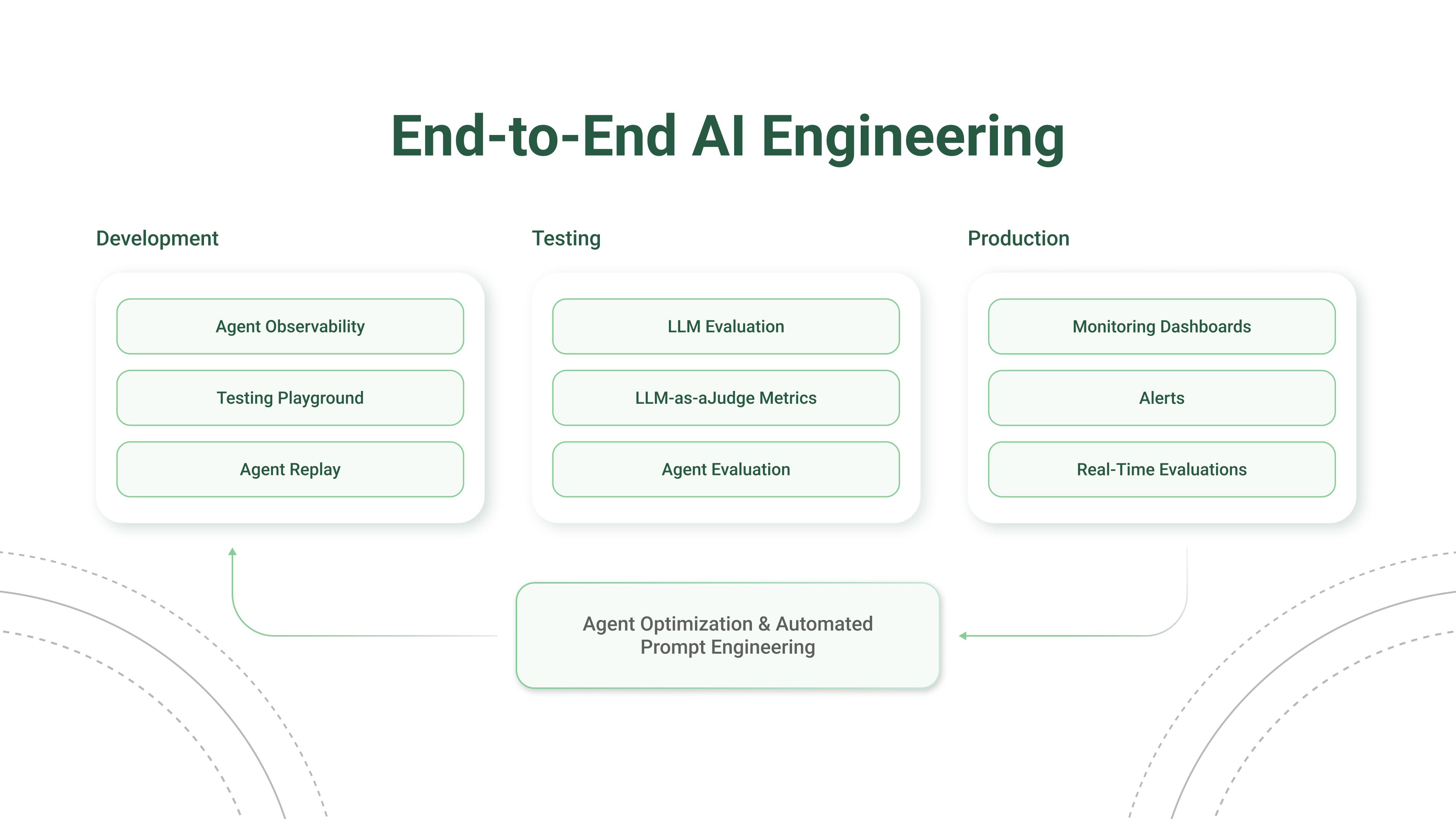 Opik is Open Source! You can find the full source code on [GitHub](https://github.com/comet-ml/opik) and the complete
self-hosting guide can be found [here](/self-host/local_deployment).
## How to use Opik
**Using Claude Code, Cursor, or VS Code Copilot?** Install the [Opik MCP server](/mcp-server) and drive your entire workspace from chat — read traces, score outputs, save prompts, and run experiments without opening the UI.
### See what your application is doing
Opik records every LLM call, tool invocation, and agent step so you can inspect the full chain of events that led to any output. Add a few lines of code and you'll have a complete log of every request and response.
[Start logging traces →](/tracing/getting-started)
### Build test suites from your traces
When you spot a trace that looks wrong, turn it into a test case. Use [Ollie](/ollie) to do this automatically (just describe what went wrong), or add test cases through the UI or SDK. Then run your test suite with Ollie or from the SDK to verify your fixes.
Over time, your test suite grows from real production failures, not hypothetical examples.
[Build your first test suite →](/evaluation/advanced/building-test-suites)
### Track quality in production
Set up online evaluation rules that automatically score incoming traces, and monitor feedback scores, latency, cost, and error rates from the project dashboard.
[Set up production monitoring →](/production/online-evaluation/rules)
### Automatically improve your prompts
Opik's optimization algorithms test variations of your prompts against your metrics and datasets to find what works best, without manual trial and error.
[Run your first optimization →](/development/optimization-runs/quickstart)
## Explore by feature
Get Opik running with your existing AI stack in minutes. Works with OpenAI, Anthropic, LangChain, and 50+ other providers and frameworks.
Connect Claude Code, Cursor, or VS Code Copilot directly to your Opik workspace. Read traces, score outputs, and run experiments from chat — no UI required.
Record every LLM call, tool invocation, and agent step. Debug failures, track token costs, and understand what your application is doing.
Score your application on hallucination, context recall, relevance, and more using automated LLM-as-a-judge and heuristic metrics.
Automatically generate and test better prompts for every step in your agent using six optimization algorithms.
Store and version your prompts, compare results in the [Prompt Playground](/development/prompt-playground), and experiment with different models.
Deploy on your own infrastructure with Docker locally or Kubernetes at scale. Full control over your data.
## See it in action
## Open-source access meets enterprise performance
All Opik versions ([cloud](https://www.comet.com/signup?from=llm),
[open source](https://github.com/comet-ml/opik), and
[enterprise](https://www.comet.com/site/pricing/)) include the full AI engineering feature set
and run on the Comet platform, with proven performance at scale supporting many of the world's
largest organizations.
> Debug, evaluate, and monitor your LLM applications, RAG systems, and agentic workflows with comprehensive tracing, automated evaluations, and production-ready dashboards.
Opik is Open Source! You can find the full source code on [GitHub](https://github.com/comet-ml/opik) and the complete
self-hosting guide can be found [here](/self-host/local_deployment).
## How to use Opik
**Using Claude Code, Cursor, or VS Code Copilot?** Install the [Opik MCP server](/mcp-server) and drive your entire workspace from chat — read traces, score outputs, save prompts, and run experiments without opening the UI.
### See what your application is doing
Opik records every LLM call, tool invocation, and agent step so you can inspect the full chain of events that led to any output. Add a few lines of code and you'll have a complete log of every request and response.
[Start logging traces →](/tracing/getting-started)
### Build test suites from your traces
When you spot a trace that looks wrong, turn it into a test case. Use [Ollie](/ollie) to do this automatically (just describe what went wrong), or add test cases through the UI or SDK. Then run your test suite with Ollie or from the SDK to verify your fixes.
Over time, your test suite grows from real production failures, not hypothetical examples.
[Build your first test suite →](/evaluation/advanced/building-test-suites)
### Track quality in production
Set up online evaluation rules that automatically score incoming traces, and monitor feedback scores, latency, cost, and error rates from the project dashboard.
[Set up production monitoring →](/production/online-evaluation/rules)
### Automatically improve your prompts
Opik's optimization algorithms test variations of your prompts against your metrics and datasets to find what works best, without manual trial and error.
[Run your first optimization →](/development/optimization-runs/quickstart)
## Explore by feature
Get Opik running with your existing AI stack in minutes. Works with OpenAI, Anthropic, LangChain, and 50+ other providers and frameworks.
Connect Claude Code, Cursor, or VS Code Copilot directly to your Opik workspace. Read traces, score outputs, and run experiments from chat — no UI required.
Record every LLM call, tool invocation, and agent step. Debug failures, track token costs, and understand what your application is doing.
Score your application on hallucination, context recall, relevance, and more using automated LLM-as-a-judge and heuristic metrics.
Automatically generate and test better prompts for every step in your agent using six optimization algorithms.
Store and version your prompts, compare results in the [Prompt Playground](/development/prompt-playground), and experiment with different models.
Deploy on your own infrastructure with Docker locally or Kubernetes at scale. Full control over your data.
## See it in action
## Open-source access meets enterprise performance
All Opik versions ([cloud](https://www.comet.com/signup?from=llm),
[open source](https://github.com/comet-ml/opik), and
[enterprise](https://www.comet.com/site/pricing/)) include the full AI engineering feature set
and run on the Comet platform, with proven performance at scale supporting many of the world's
largest organizations.
> Debug, evaluate, and monitor your LLM applications, RAG systems, and agentic workflows with comprehensive tracing, automated evaluations, and production-ready dashboards.